How Much Does a Fractional CTO Cost?
The published benchmarks, the number I charge, and the arithmetic that turns any retainer into an hourly rate
Startups shopping for engineering leadership start by searching what a fractional CTO costs, but every page ranking for that question answers with a range wide enough to park a bus in and a button that books a call. You cannot budget against a range like that, so the decision gets made badly in one of two directions, either over-hiring a full-time executive whose fully loaded cost quietly eats a quarter of your runway, or under-scoping the whole thing down to a few hours a month that cannot possibly move anything, and both of those happen because of a number nobody in this market will put in writing. By naming what esence.io charges, showing the arithmetic that turns any retainer into an hourly rate, and explaining why my number sits well below the published benchmarks, I want you to leave this page able to price the thing yourself.
The reason nobody publishes it is not really a mystery. A published price is a position you have to defend, and a range is a position you can move after you've heard your prospect's funding stage, which is a polite way of saying the number is partly a function of what they think you can pay. I've been on the buying side of that conversation and it is a rotten way to plan a budget.
So here's what the missing number actually costs a founder who is trying to do this properly:
- You cannot compare the option against a full-time hire, which is the only comparison that matters, because one side of it is a salary you can look up and the other side is "it depends".
- You walk into a scoping call already anchored, since the first number spoken aloud in that room is going to be theirs and not yours.
- You end up buying hours instead of buying judgement, because hours are the only part of the offer that was ever legible to you.
The market context sits in what a fractional CTO costs and the four charging models, and if you would rather skip both, what moves the number underneath the hours is the section that actually explains your quote. What this buys you in runway and the common questions are at the bottom.
How much does a fractional CTO cost?
A fractional CTO costs between roughly $150 and $500 an hour, or between $8,000 and $30,000 a month on retainer, with the monthly figure tracking how many days a week the engagement actually covers. That is the market answer, and it is worth having in front of you before I tell you mine, because a number without a market around it is just a number.
The two most specific public breakdowns I can point you at, both current as of this writing:
Kompella's 2026 pricing guide (published 30 April 2026, updated 25 August 2026) splits the retainer into three tiers by commitment: $8,000 to $10,000 a month for advisory work at one day a week, $15,000 to $18,000 for a fractional engagement at two days a week, and $25,000 to $30,000 for an embedded one at three days or more. It puts hourly work at $200 to $500, day rates at $1,500 to $4,000, and adds a 20 to 40 percent premium for healthtech, fintech and applied AI.
HyperNest Labs publishes a market table by geography, at $275 to $350 an hour in San Francisco and New York, $200 to $275 in Austin, LA and Miami, and $150 to $200 in smaller US markets. Read that one knowing it sits on a page selling a $60 an hour alternative, so the market ranges above it are doing a job. The geographic spread is still the useful part, and it is consistent with everything else published on this.
Both agree on the shape even where they disagree on the digits. Price tracks days per week, location and vertical risk, roughly in that order.
What you are actually buying when you buy hours
The hours are the unit, but the hours are not the product, and conflating the two is how founders end up with a technical leader who attends everything and decides nothing. What you are buying is the number of decisions someone can make about your system per month, and hours are simply the crudest available proxy for that.
Three things move the real cost underneath the hours.
Response latency, which is priced separately from volume
Being reachable inside a couple of days is a different product from being reachable the same afternoon, and it is a different product again from sitting in your standup on Tuesday. The volume of work can be identical across all three. What changes is how much of my week has to stay unscheduled to make the promise true, and unscheduled time is the actual inventory in this business.
Whether you already have engineers
Leading a team that exists is cheaper in hours than being the team. A pre-hire startup buys substantially more hours to travel the same distance, since somebody has to convert the architecture into commits and that somebody is briefly going to be me. This is the single biggest reason two companies get quoted differently for what sounds like the same engagement.
The age and shape of the codebase
An audit of a two-year-old system with no tests is not the same work as reviewing a service somebody wrote last quarter, and it gets priced by how long it takes to build an accurate picture rather than by how many files it contains. Nobody can quote this part honestly without looking first, which is why a scoping call exists at all.
How does the market charge for a fractional CTO?
The market bills in one of four structures, and picking the wrong structure costs a founder more than picking the wrong practitioner does. Every number in the table below belongs to the market rather than to esence.io. The figures come from the two sources cited above, and I have kept my own bands out of the table deliberately, so that you get to read the shape of the market before you read my pitch. What I charge is the next section, and it is lower than all of this.
| Model | Published market range, 2026 (not esence.io) | What it is good at | What goes wrong | Choose this when |
|---|---|---|---|---|
| Hourly | $150 to $500 per hour | Small, bounded, verifiable work | You stop asking the cheap five-minute questions, which are the valuable ones | The work has a definite end, like a due diligence or one architecture decision |
| Day rate | $1,500 to $4,000 per day | Workshops, audits, an intensive week | Nobody is accountable between the days | You need a block of deep work and no ongoing relationship |
| Monthly retainer | $8,000 to $30,000 per month | Continuity, and questions answered before they become incidents | You pay in quiet months too | You need a technical leader who is reachable on a cadence you can plan around |
| Project / fixed scope | $15,000 to $75,000 per project | A named deliverable with a date | Scope moves, and then the relationship is about the contract | The outcome is specific enough to write down in one sentence |
Sources for that column: Kompella's 2026 pricing guide for the hourly, day, retainer and project figures, and HyperNest Labs for the lower bound on hourly work outside the major US markets.
What esence.io charges, and the hourly rate hiding inside it
A fractional CTO engagement at esence.io runs from $1,500 to $6,500 a month, and the full detail of what each band covers and deliberately does not cover lives on the pricing page. The part worth doing here is the arithmetic, because a monthly retainer is designed to be hard to compare and it takes about ten seconds to make it comparable.
Convert every band to an hourly rate on the same basis, which is the monthly figure divided by the hours it actually buys. A month is 52 weeks divided by 12, or about 4.33 weeks. I am counting a working day as eight hours, and that is an assumption you should feel free to change:
| Band | Per month | What that buys | Hours a month | Works out at |
|---|---|---|---|---|
| Starter | $1,500 | up to 10 hours, async | 10 | $150 / hour |
| Growth | $3,500 | 4 hours weekly | 4 × 4.33 = 17.3 | $202 / hour |
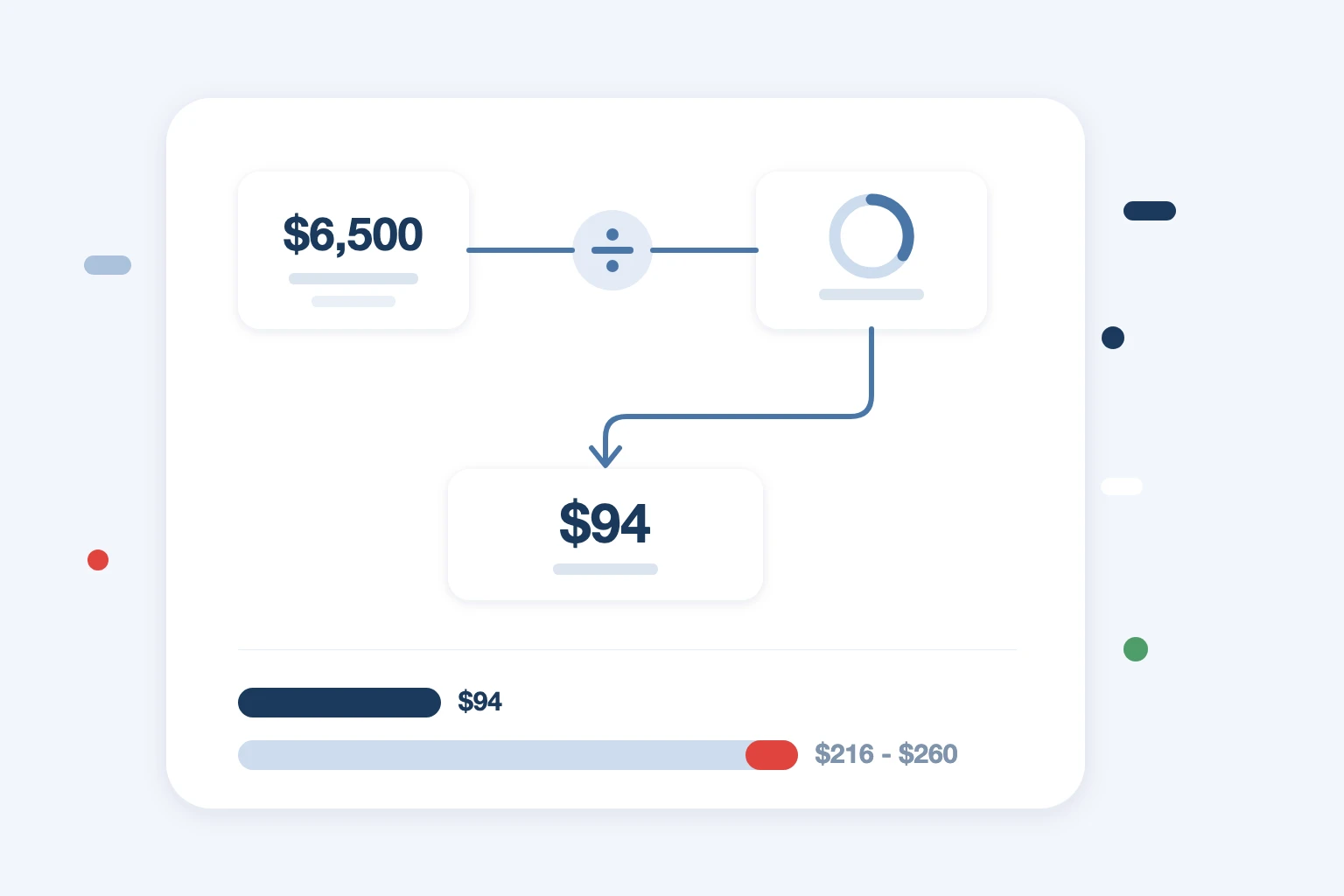
| Enterprise | $6,500 | 2 days weekly | 16 × 4.33 = 69.3 | $94 / hour |
Now run the identical sum on the benchmark. Kompella's fractional tier is $15,000 to $18,000 a month for two days a week, which is exactly the commitment my top band describes, so it divides by the same 69.3 hours and lands between $216 and $260 an hour. My top band works out at $94. Same hours, same week, roughly 40 percent of the published rate.
Notice also that my cheapest hour is at the top of the range rather than the bottom, which is the opposite of how the bands look at a glance. You are buying volume, and the entry band prices the overhead of context-switching into a codebase for ten hours a month rather than the hours themselves.
Working out your own number
Do not take my arithmetic and do not take the benchmark's. Do this instead, in about fifteen minutes, with your own figures.
1. Cost the full-time hire properly
The comparison founders reach for is a retainer against a salary, and it is the wrong one, because a salary is not what a hire costs. Add the base salary, the employer taxes and benefits on top of it, the equity grant priced at your last round rather than at zero, the recruiter fee if you are using one, and then the months of ramp before the person is making good decisions inside your codebase rather than good decisions in general. Divide the total by twelve.
2. Price the mis-hire
Multiply the number from step one by the odds you get it wrong, honestly assessed, and add that back in. A senior engineering hire that does not work out costs you the search again, the severance, and roughly two quarters of a roadmap. Founders systematically leave this line out, which is precisely why the fractional option keeps looking more expensive on a spreadsheet than it turns out to be in a year.
3. Convert every quote you have to the same hourly basis
Run the sum above on each one. A $12,000 retainer for one day a week and a $6,500 retainer for two are not thirteen thousand dollars apart in any meaningful sense, they are about three times apart per hour, in the direction you would not guess from the monthly figure.
4. Decide what you are short of
If you are short of decisions, buy fractional. If you are short of presence, which is what it feels like when four engineers need someone in the room every day rather than someone right twice a week, no retainer is going to fix it and you should be hiring. That line sits somewhere around the fifth to tenth engineer for most companies I've watched go through it.
Why the quote you were given looks nothing like this
Why is one quote three times another for the same brief?
Because the rate prices a cost structure and not an hour of judgement. An agency number carries a salesperson, an account manager, an office, and a bench of engineers who get paid in the months they are not staffed on anything, and all of that is real money that has to come from somewhere before anyone opens your codebase. I carry none of it. That is most of the gap in the arithmetic above, and it is worth being precise about, because the interesting question is not why mine is low but what the extra $120 to $165 an hour buys you elsewhere.
So what am I giving up at that price?
Capacity, mainly, and you should weigh it. There is no bench behind me, so there is no surge team when your launch goes sideways, no second architect to escalate to when I am wrong about something, and no cover when I take a week off. My availability is finite in a way an agency's is not, which is why the hours on each band are real numbers rather than an opening position. If your risk model needs redundancy in the person, buy the agency and pay the premium knowingly, because that premium is not a scam, it is insurance and it is priced about right.
Why is the number on the website at all?
A price you have to book a meeting to hear is a price somebody is still deciding, and what they are deciding it against is you. Publishing it costs me the ability to charge a funded Series A more than a bootstrapped team for identical work, which is a real cost and I've taken it deliberately. It also means the scoping call starts at whether I am useful to you instead of at whether you can afford me.
Why does the geography matter more than anyone admits?
Rate benchmarks in this market are US market benchmarks, and HyperNest's own table prices smaller US markets at $150 to $200 an hour against $275 to $350 in San Francisco and New York for identical work. Suraj Upadhyay is one person working from outside those markets, and a meaningful part of the gap between my bands and the published range is simply that, rather than anything clever about the operating model that I could sell you.
Frequently asked questions
How much does a fractional CTO cost per month? Published 2026 benchmarks put a fractional CTO retainer somewhere between $8,000 and $30,000 a month depending on how many days a week the engagement covers, and hourly work between $150 and $500. At esence.io the bands run from $1,500 to $6,500 a month, which is lower than the benchmark for reasons of cost structure rather than seniority.
Is a fractional CTO cheaper than hiring a full-time CTO? Below roughly five to ten engineers, almost always, because the comparison is not retainer against salary. A full-time hire carries employer taxes, benefits, an equity grant priced at your last round, a recruiter fee, and several months of ramp before the decisions get good. Add those up, divide by twelve, and compare that against a monthly retainer.
Why do fractional CTO rates vary so much between providers? Because the rate prices a cost structure and not an hour of judgement. An agency rate carries a sales team, an account manager, and a bench of people who are paid whether or not they are staffed on your account. A solo practitioner carries none of that, and the difference shows up in the number rather than in the work.
Should I pay a fractional CTO hourly or on a monthly retainer? Pay hourly when the work has an end, like a due diligence or a single architecture decision, because you should not buy availability you do not need. Pay a retainer when you need someone reachable on a predictable cadence, since hourly billing quietly discourages the small five-minute questions that are usually the highest-value part of the engagement.
When does a fractional CTO stop being the cheaper option? When people management becomes the bottleneck instead of architecture, which usually lands somewhere past the first five to ten engineers and a funded round. At that point you are buying presence rather than decisions, and presence is the one thing a fractional engagement is structurally bad at selling you.
What the number buys, in runway terms
The reason any of this arithmetic matters is that the difference between $6,500 and $18,000 a month is $138,000 a year, which at seed stage is an engineer and a half, and runway is the only asset that converts directly into more attempts at product-market fit. That is the whole case, and notice that it does not require me to be better than the $18,000 option, only close enough that the difference buys you something you needed more.
What that money is actually spent on, once it stops being spent on a retainer, is the part I care about. Some of it is spent by not spending it at all, which is what deciding whether to build or buy a subsystem comes down to. The rest goes into getting your monorepo right from day one so a new engineer ships in their first week rather than their third, cutting the build times that tax every engineer on the payroll, and making your database enforce tenant isolation before an enterprise buyer asks you to prove that it does. If you want the broader argument for the model rather than the price of it, that lives in why startups should hire a Fractional CTO, and the band-by-band detail lives on the pricing page.
Anyway, this has turned into a longer post about money than I meant to write, and there's a whole other question sitting underneath it that I've only waved at here, which is when you make this call rather than what it costs. That one needs its own post about the signals that tell you a fractional engagement has run its course and it's time to hire properly, and I'll put that up next.
⚡ Price Your Engineering Leadership Honestly
You are trying to budget for a technical leader and every quote you have is a range with a call attached. That uncertainty is costing you either runway you did not need to spend or a decision you keep postponing.
At esence.io, I step in as your Fractional CTO to audit what you have, name what it will take to fix, and scope the engagement to hours you can actually plan around.